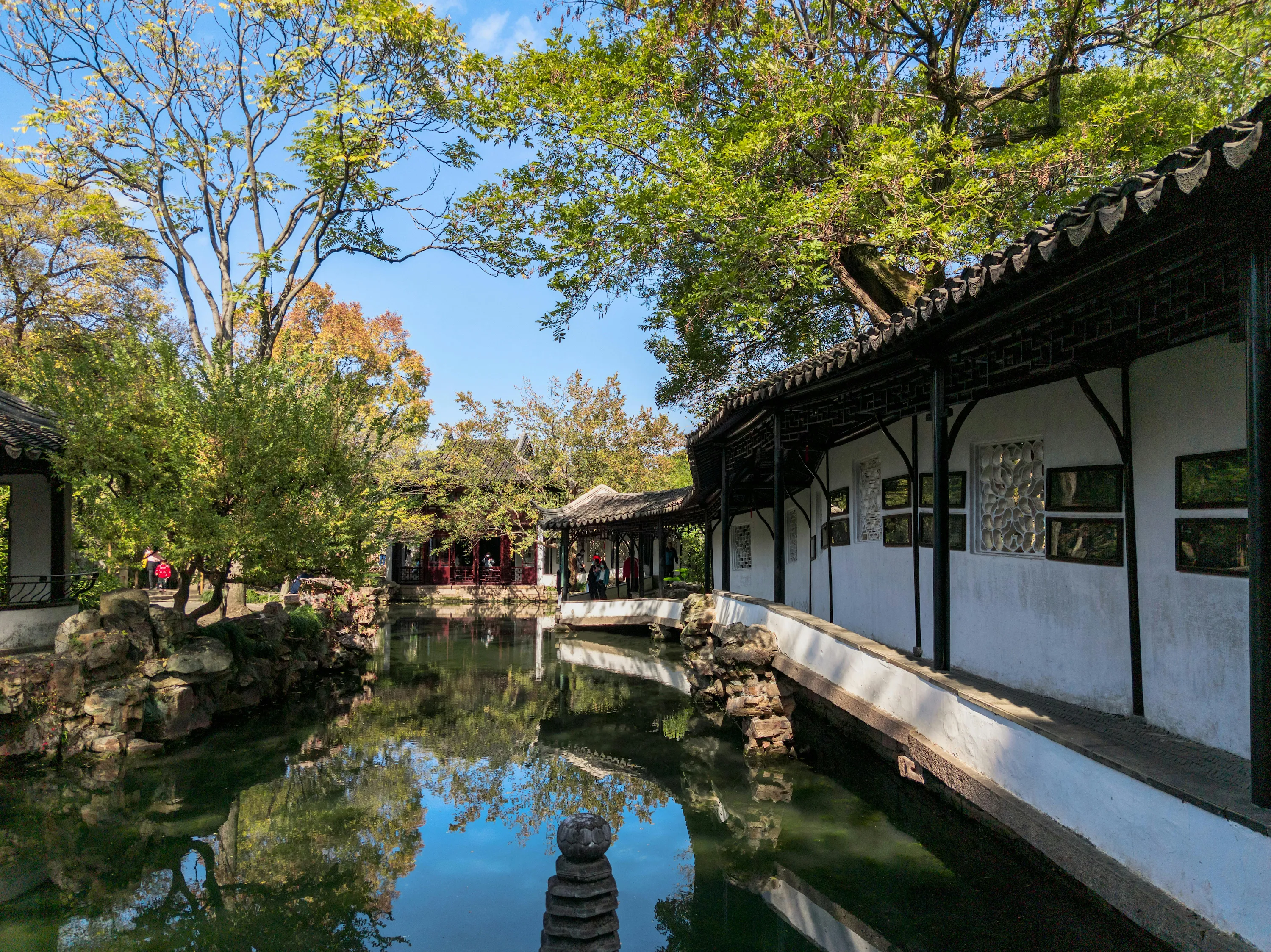
Jiangsu Province
🌿 Suzhou
China's garden city — nine UNESCO-listed classical gardens, silk workshops, and canal-side whitewashed houses 25 minutes from Shanghai by high-speed train. The most refined and beginner-friendly destination on this list.
- ⭐ FIT Rating
- 8.5/10
- 🕐 Ideal Stay
- 1–2 days
- 🗣️ English
- Medium in tourist areas — garden staff usually have basic English
- 📱 Digital
- Good
Why this city
Suzhou is the most refined city in China and the most likely to be underestimated. Visitors coming from Shanghai tend to expect another dense, loud city and instead find narrow canal streets, whitewashed courtyard walls, and classical gardens that have been under continuous cultivation for five hundred years. The scale is deliberately human. Almost everything worth seeing is within a two-kilometre radius of the old city center, and the pace — by Chinese standards — is almost meditative.
The case for Suzhou is also a case against rushing it. Most people who visit do so as a day trip from Shanghai and see one garden, walk Shantang Street, and leave. That is a valid itinerary. But Suzhou after the day-trippers leave — in the early morning before the gardens open, or in the evenings when the canal streets are lit — is substantially better than the tourist version. If you can arrange a single overnight, the city repays it.
A note on expectations. Suzhou is not ancient in the way Xi’an is ancient. The gardens are immaculately restored, the pedestrian streets have been heavily commercialised, and the UNESCO framing can set up a slightly disappointed encounter with what are, in places, quite polished tourist environments. The value is in the aesthetic — the arrangement of stone, water, and plant into a particular kind of beauty that has no real equivalent in Europe or the Americas — and in understanding what “cultivated landscape” meant to the scholar class that built these spaces. That framing makes the experience considerably richer.
The signature experiences
The Humble Administrator’s Garden (拙政园, Zhuozheng Yuan). The largest and most celebrated garden in Suzhou. Plan 90 minutes minimum — it’s easy to spend two hours. Arrive at opening (7:30am) to walk it before the tour groups. The central lake section is the masterpiece; the western and eastern sections are quieter and often better for photographs.
The Lingering Garden (留园, Liu Yuan). More intimate than the Humble Administrator’s, with a famous sequence of window-framed views called the guanyun tower approach. Often considered the most architecturally sophisticated of the four major Suzhou gardens. Allow 60–90 minutes.
The Suzhou Museum (I.M. Pei, 2006). Next door to the Humble Administrator’s Garden, and one of the most beautiful contemporary buildings in China. Pei — Suzhou-born — designed it as a dialogue between classical garden architecture and modern minimalism. The permanent collection is strong on Suzhou silk and local art. Free admission; timed entry required. Book online.
Pingjiang Road. A 1.6-kilometre historic street running along a canal in the northeastern old city. Less commercialised than Shantang Street and better for simply walking. Early morning is when it functions as a real neighbourhood rather than a tourist attraction — elderly residents doing tai chi, breakfast stalls, canal boats moving supplies.
Shantang Street. The iconic canal street, heavily touristed but genuinely photogenic. Best at dusk when lanterns illuminate the water. Arrive by 5pm to walk it before the evening rush; by 8pm it is extremely crowded.
The Silk Museum. Covers 4,000 years of Suzhou silk production with working looms, historical samples, and a clear explanation of why Suzhou silk (particularly the double-sided embroidery) commands the prices it does. Two hours is sufficient. The attached shop sells genuine product; be prepared for prices that reflect actual craftsmanship.
Tiger Hill. A pagoda-topped hill west of the old city, less visited than the gardens but worth a half-day. The leaning pagoda (Yunyan Pagoda, over a thousand years old) is the centrepiece; the sword pool and surrounding landscape gardens are genuinely beautiful.
Tongli water town. A short bus ride from Suzhou and far more atmospheric than the more famous Zhouzhuang. Three small lakes, a stone bridge system, and a compact historic centre that feels genuinely lived-in rather than theme-parked.
The neighborhoods
Old City (within the ring canals). The core of what makes Suzhou worth visiting. Most gardens, museums, and canal streets are here. Dense with tourists during the day; pleasantly empty by 7am and after 8pm. Hotels here range from renovated courtyard guesthouses to small boutique properties; rarely the big chains.
Guanqian Street area. The main commercial strip — international brands, local food chains, Pearl pagoda shopping mall. Useful but not distinctive. Worth passing through for street food; not where you want to linger.
Pingjiang district. The best neighbourhood in the old city for a wander without a fixed plan. Residential streets branch off the main road toward quiet canals; architecture is unrenovated enough to feel authentic without being derelict. Some of Suzhou’s best small restaurants and teahouses are tucked in here.
Suzhou Industrial Park (SIP). The modern eastern district, built as a joint Singapore–China development zone. Jinji Lake, the opera house, and various upscale hotels are here. Architecturally bland but pleasant for evening walks along the lake. Where you end up if you book a chain hotel.
Food
Suzhou cuisine belongs to the Huaiyang tradition — the most refined and subtle branch of Chinese cooking. Where Sichuan cuisine announces itself through heat and numbing spice, Suzhou cuisine whispers. The dominant flavors are sweet, delicate, and soy-forward, with a precision in preparation that reflects the city’s historical association with scholarly culture.
Squirrel-shaped Mandarin fish (松鼠鳜鱼, songshu guiyu) is the city’s most famous dish: a whole fish scored in a pattern that puffs open when fried, then dressed with a sweet-and-sour sauce. The theatrical presentation matches the flavour. Order it at a sit-down restaurant; the versions at tourist street stalls are universally disappointing.
Shrimp noodles (虾仁面) served in a pale, clear broth are the local breakfast. Locals eat them standing at small stalls by 7am. The broth is made from long-simmered eel bones; the shrimp are Taihu Lake freshwater prawns. Nothing costs more than ¥25.
Braised pork with preserved vegetables (梅菜扣肉) and Suzhou-style wontons (馄饨) in clear broth are the staples of any decent local restaurant. Drunken crab (醉蟹) is the autumn delicacy — small Taihu Lake crabs marinated raw in Shaoxing wine, a Suzhou specialty that other cities rarely do as well.
For sweets and snacks, the lanes near Guanqian Street sell pine nut candy (松子糖), Suzhou-style mooncakes (苏式月饼 — pastry-shell style, available year-round), and agarwood cakes (沉香糕). These are genuinely local and make the best edible souvenirs.
For a full meal, avoid the tourist restaurants directly in front of the garden gates — they are expensive and generic. Walk two streets away for restaurants serving actual Suzhou cooking at a third of the price.
Getting around
Metro. Suzhou now has four lines. Line 1 runs east–west through the old city and connects to Shanghai via Suzhou Rail Transit at Suzhou Railway Station. Line 4 covers the SIP district. Lines 2 and 3 expand coverage to the newer districts. ¥2–6 per ride; the same Alipay QR-code payment used in Shanghai works here.
Bicycles. The most enjoyable way to move through the old city. Meituan Bike and Hello Bike have good coverage. The canal-side lanes and Pingjiang Road are well-suited to cycling; traffic is lighter than Shanghai. Avoid cycling on Shantang Street on weekends — it becomes pedestrian-only in the afternoon.
Taxis and Didi. Plentiful and cheap. The old city is compact enough that most rides are under ¥15. Show destinations in Chinese — taxi drivers outside tourist areas rarely speak English.
Walking. The old city rewards walking above all other methods. From the Humble Administrator’s Garden to Pingjiang Road is under fifteen minutes on foot; from Pingjiang Road to Shantang Street is twenty. Wear comfortable shoes — the traditional stone street surfaces are uneven.
A 48-hour itinerary
Day 1 — Gardens and canals.
- Early morning (7:00–9:00am). Humble Administrator’s Garden at opening, before tour groups arrive. Walk the whole garden at your own pace.
- Mid-morning. Suzhou Museum next door — plan 90 minutes.
- Lunch. Shrimp noodles or wontons at a small restaurant on Lindun Road.
- Afternoon. Lingering Garden (1.5 hours), then Tiger Hill if energy allows.
- Evening. Walk Pingjiang Road at dusk, then dinner on one of the smaller streets nearby. Avoid the tourist restaurants immediately facing the canal.
Day 2 — Silk, streets, and departure.
- Morning. Silk Museum (2 hours). If buying silk — embroidered artwork, not clothing — buy here; the prices are high but the quality is guaranteed.
- Late morning. Walk Shantang Street from the west entrance toward the canal section.
- Lunch. Squirrel fish at a proper local restaurant on Shiquan Street.
- Afternoon. Return to Shanghai. The high-speed train takes 24 minutes from Suzhou Railway Station.
A 5-day itinerary
Suzhou is most naturally part of a Yangtze Delta loop rather than a standalone 5-day destination. The framework below uses Shanghai as a base.
Day 1. Arrive in Shanghai. French Concession afternoon, Bund at dusk.
Day 2. Day trip to Suzhou: Humble Administrator’s Garden + Suzhou Museum morning, Pingjiang Road and Shantang Street afternoon, return to Shanghai.
Day 3. Overnight in Suzhou: check in, Lingering Garden and Tiger Hill, Tongli water town in the afternoon (30-min bus), Shantang Street evening.
Day 4. Suzhou silk museum and old city streets, afternoon train to Hangzhou (30 minutes). West Lake evening.
Day 5. Hangzhou morning (West Lake, Longjing tea village), afternoon return to Shanghai for departure.
Day trips
Tongli (30 minutes by bus from Suzhou station). The most atmospheric water town in the region — three lakes, historic bridges, and a genuinely lived-in community rather than a theme park. Half-day is enough. Far better than the more famous Zhouzhuang.
Zhouzhuang (45 minutes). More famous, more photographed, more touristed, and — honestly — less interesting than Tongli. Worth visiting if you haven’t been to any water town before; skip it in favour of Tongli if you have a choice.
Wuzhen (1.5–2 hours by bus). The most visually spectacular water town in the region, with two distinct scenic zones. Better as an overnight than a day trip. Strong commercial overlay but the eastern zone at dawn, before the crowds arrive, is genuinely beautiful.
Shanghai (24 minutes by high-speed rail). Suzhou’s proximity to Shanghai makes it possible to do day trips in both directions. From Suzhou, Shanghai’s evening restaurant scene and entertainment options extend a Suzhou stay significantly.
Culture and etiquette
Garden pace. Classical gardens reward stillness. Visitors who rush through in 20 minutes — taking photographs at the posted “viewpoints” and moving on — miss the point. The experience is in sitting by the water, watching how the same scene shifts in different light, noticing how the rock formations frame or block specific views. The gardens are designed to slow you down; let them.
The stone bridges and canal paths. Most canal paths in the old city are shared by residents and visitors. The residents live here. Avoid blocking narrow lanes for photographs, and treat occupied residential courtyards as private property even when they look photographable from the street.
Bargaining for silk. The silk market near the gardens operates on expectation of negotiation — starting prices for embroidered artwork are typically two to three times the expected final price. However, the Silk Museum shop and reputable silk stores have fixed prices and are worth using for the quality guarantee. The ¥80 handkerchief being sold as “pure silk hand embroidery” by street vendors near the gardens is neither.
Dialect. Suzhounese is a Wu dialect with no mutual intelligibility with Mandarin. Older residents speak it exclusively. Mandarin works fine throughout the tourist areas; the effort of attempting even a word of Mandarin is appreciated more here than in Shanghai, where English is more expected.
Common scams
Silk quality fraud. The most common scam in Suzhou by a significant margin. Machine-woven polyester is sold as handwoven silk; machine-embroidered fabric is sold as hand-embroidered. Tests: real silk burns like hair and leaves a crushable ash; polyester melts and smells chemical. For significant purchases, use the Silk Museum shop or a reputable fixed-price store rather than the market stalls adjacent to the gardens.
Tourist restaurant overcharging. Restaurants on Shantang Street and directly facing the Humble Administrator’s Garden routinely charge two to three times local prices for dishes that are no better than what you’ll find two streets away. Menu prices are posted at the door by law; if there’s no price list visible, ask before sitting down.
Garden ticket scams. Unofficial touts near garden entrances sometimes offer “bundled” tickets for multiple gardens at discounted prices. These are either counterfeit or for gardens not on your itinerary. Buy at the official gate.
What surprises first-time visitors
How many Chinese tourists there are. Suzhou is a prestige domestic tourism destination — on weekends and national holidays, the gardens can hold 10,000+ visitors simultaneously. The experience on a Tuesday in November and on a Saturday in October are completely different. Plan accordingly.
How walkable the old city is. The entire cluster of gardens, museums, and canal streets fits within a 2.5km × 2km rectangle. Most visitors rent a car or take taxis between sites they could have walked between in twelve minutes.
The quality of the Suzhou Museum. Visitors who know I.M. Pei’s work (the Louvre Pyramid, the East Wing of the National Gallery) are usually prepared; everyone else tends to be surprised by the quality of a free civic museum in what they assumed was a secondary Chinese city.
How different the food is from Shanghai. Both are Yangtze Delta cuisines, but Suzhou’s sweetness and delicacy are more pronounced. If you’re expecting Shanghai-style soup dumplings, you’ll find something distinct and worth its own attention.
Where this fits in a first China trip
Suzhou is best positioned as a supporting cast member rather than a headliner. For a first China trip, it works best as:
Day trip from Shanghai — the minimal viable experience. Takes 24 minutes each way by high-speed train. See one or two gardens, walk Pingjiang Road, return in the evening.
Overnight extension from Shanghai — significantly better. The evening canal atmosphere and the early morning garden experience before the crowds are the two things that justify spending the night.
Part of a Yangtze Delta loop — Suzhou + Hangzhou + Shanghai as a 5–7 day circuit covers the most aesthetically coherent region in China: classical gardens, West Lake landscape, and the most international Chinese city. This is the strongest framework for a first trip that doesn’t want to cover too much ground.
What Suzhou is not: a standalone destination that justifies flying directly there as the primary stop on a first China visit. It earns its place as the most beautiful day trip in China, which is a significant distinction.