Chongqing Municipality
🌉 Chongqing
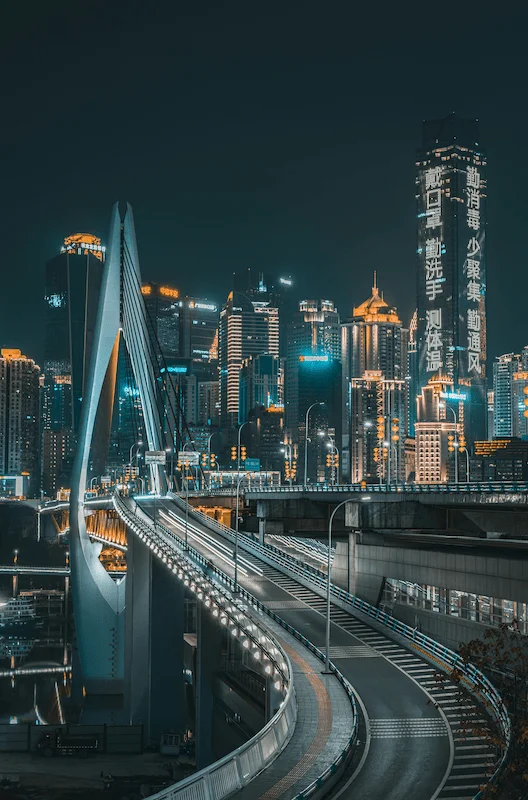
China's most dramatic city — built vertically across mountain ridges above the Yangtze and Jialing rivers. Chongqing's fiery hotpot is the original, its neon-lit hillside skyline is unlike anywhere else, and the Three Gorges cruise begins here.
- ⭐ FIT Rating
- 8.5/10
- 🕐 Ideal Stay
- 3–4 days
- 🗣️ English
- Low — Mandarin and Sichuanese dialect dominate
- 📱 Digital
- Excellent
Why this city
Chongqing breaks every Chinese city template. There is no flat ground. The city is built across a series of mountain ridges above the confluence of the Yangtze and Jialing rivers, and the topography forced engineers and architects into solutions — cliff-side elevator shafts, bridges at five different levels, a monorail that runs through the middle of a residential apartment block — that belong in a science fiction novel rather than a contemporary city of thirty million people. At night, when the LED-lit ridgelines glow against the river fog and the cable car crosses silently above the water, Chongqing looks like the future that the twentieth century imagined but never built.
The food is the other thing. Chongqing hotpot — the original, not the Chengdu version that most people outside China have encountered — uses a beef tallow base that is simultaneously more intensely spiced and more complex than its younger sibling. Sitting around a bubbling cauldron of Sichuan pepper and dried chilli oil with a group of people willing to eat for two hours is the correct way to spend an evening in Chongqing. The question is not whether to do it, but how to manage the physical aftermath.
Chongqing is also the departure point for the Three Gorges cruise, the most dramatic river journey in China — a slow boat through 192km of river gorge between sheer limestone walls, past partially submerged ancient ghost towns and the engineering marvel of the Three Gorges Dam. The full cruise takes three to five days; the express version (Three Gorges Express) covers the best scenery in a single day.
A seasonal note: Chongqing is one of China’s “Three Furnaces” — cities where summer heat (35–40°C in July and August) combines with extreme humidity and minimal wind. Spring and autumn are when the city is at its most livable. Winter is grey, mild, and fog-wrapped; the characteristic Chongqing aesthetic.
The signature experiences
Hongya Cave (洪崖洞) at night. An 11-story stack of traditional stilted buildings (diaojiao lou) built into a cliff face above the Jialing River, now converted into a restaurant and retail complex. By day, it is a tourist attraction of moderate interest. After dark, when the lanterns and LED lighting transform each floor into a different colour and the reflections multiply in the river below, it becomes the image most visitors came to Chongqing expecting but weren’t sure they’d find. Stand on the Qiansimen Bridge across the river for the best photograph.
The monorail through the Liziba apartment building (李子坝站). Line 2 of the Chongqing Rail Transit exits a tunnel and passes through the sixth to eighth floors of a residential apartment block — not alongside it, but through it, with the track running through a purpose-built opening in the building. Residents have lived beside the train for over a decade and ignore it. Take Line 2 to Liziba station, ride it inbound through the building, and watch the building residents’ windows pass by at arm’s length. Then stand on the viewing platform outside the station and watch subsequent trains make the same pass.
Jiefangbei CBD. The commercial heart of the city — a pedestrianized zone of high-rises, underground malls, and the giant Jiefang Monument at its centre. Entirely modern, somewhat comparable to any prosperous Chinese city center during the day, but significantly more interesting at night when the surrounding towers illuminate and the density of the commercial activity becomes apparent. The underground mall system beneath Jiefangbei connects kilometers of shopping without emerging to street level.
Ciqikou Ancient Town (磁器口古镇). A Ming-dynasty riverside town that has survived into the twenty-first century as a preserved commercial and residential district. Touristy but genuine — the buildings are original, the lanes are old, and the food stalls sell local specialties rather than generic tourist food. The back streets, away from the main commercial strip, are significantly more atmospheric. Particularly good in the early morning before the crowds arrive. Accessible by metro (Line 1 to Ciqikou station).
Eling Park (鹅岭公园). A hilltop park offering the best panoramic views of the Yangtze–Jialing confluence and the surrounding urban topography. The view makes Chongqing’s geographical situation legible in a way that street-level navigation never does — you can see why every road has a different elevation, why bridges cross at four different heights, why nothing in the city is on a continuous flat grade. Visit at dusk to watch the city lights come on across the hills.
The Three Gorges Express cruise. A one-day boat journey from Chongqing downstream through the Qutang, Wu, and Xiling gorges — the most dramatic section of the Yangtze before the dam. The express service departs Chongqing in the morning and arrives at Yichang in the evening; from Yichang, high-speed rail connections run to Shanghai, Wuhan, and Beijing. The full gorge experience in one day is more than enough for most visitors. Book through your hotel or a reputable agency; cruise companies vary in quality.
Daci Temple and Guanyin Bridge area. The creative and nightlife district of Chongqing — galleries, independent restaurants, cocktail bars, and the Guanyin Bridge pedestrianized zone. The area around Daci Temple itself (a Tang dynasty Buddhist temple in active use, surrounded by contemporary commercial development) is an unusually good example of Chongqing’s capacity to layer different eras in the same city block.
The neighborhoods
Yuzhong peninsula. The original city center, occupying the narrow land between the two rivers. Jiefangbei, Hongya Cave, and most of the main commercial infrastructure are here. Extremely dense — this peninsula houses millions of people and the major shopping districts. Metro-connected and walkable if you accept that “walking” in Yuzhong involves constant elevation changes. Where most first-time visitors stay.
Nanbin Road (南滨路). The southern bank of the Yangtze — a riverfront road with a long strip of restaurants and bars facing the Yuzhong peninsula across the water. The view of the Yuzhong peninsula from here at night is outstanding. Not within walking distance of most sights; better as a dinner-and-view destination reached by taxi.
Ciqikou area (Shapingba district). The ancient town and its surrounding streets, set along a bend of the Jialing River. A university district as well as a tourist area; livelier at night than the older historic districts. The food market between Ciqikou and the university area is one of the better places to eat cheaply.
Guanyin Bridge / Jiangbei. The north shore of the Jialing — a modern commercial and entertainment district that functions as Chongqing’s answer to a nightlife zone. The pedestrianized area around Guanyin Bridge is good for late-night eating.
Neighbourhood walk — Jiefangbei to Hongyadong
A 3km walk through the vertical heart of Chongqing, taking roughly 2 hours. Chongqing’s topography makes short distances feel epic — this walk drops and climbs the equivalent of a 20-storey building between start and finish.
- Jiefangbei Square (解放碑) — The Liberation Monument at the centre of the city’s main commercial district. Start here at street level in what feels like a normal Chinese city centre — shopping malls, crowds, neon. This is the top of the ridge.
- Jiefangbei pedestrian street — Walk west through the pedestrianised shopping zone. The transition from flat commercial street to the steep descending steps of the old city happens within a few hundred metres. Follow the steps down toward the river.
- Hongyadong (洪崖洞) — The most photographed building in Chongqing — an 11-storey complex of restaurants and bars built into the cliff face on wooden stilts above the Jialing River. What appears to be the ground floor from the riverside is actually the 6th floor from street level above. Walk through all the levels rather than stopping at the obvious viewpoint; the internal staircases reveal the structure’s extraordinary integration with the rock face. Best photographed from the riverside at night when the lights reflect on the water.
- Yangtze riverside viewpoint — Walk south from Hongyadong along the riverside promenade. The confluence of the Jialing and Yangtze rivers is visible from the Chaotianmen area — the meeting of the two great rivers, the brown Yangtze and the greener Jialing, is visible as a colour boundary mid-river.
- Liziba station (李子坝) — Metro Line 2. The station where the monorail exits the hillside through an apartment building — one of the most extraordinary pieces of urban infrastructure in China. Exit the station to watch trains pass through the building from the observation deck below. The return journey on Line 2 itself (departing from Liziba) offers elevated city views for several stops.
Wear comfortable shoes. The terrain involves significant stair climbing — more vertical movement per kilometre than almost any other city walk in China.
Food
Chongqing hotpot is not Chengdu hotpot. This distinction matters, and the city will make you understand it. The Chongqing version uses a base of rendered beef tallow infused with dried chilli, Sichuan pepper, and a combination of aromatics that builds heat slowly and then doesn’t stop. The numbing-spicy (malatang, 麻辣烫) sensation — the combination of capsaicin heat and Sichuan pepper’s electric anaesthetic effect — reaches full expression here before any other city in China. Order medium spice (中辣) as a starting point; regular spice (微辣) if you’re cautious.
How to order hotpot. You receive a menu rather than food. The menu lists every ingredient that can be cooked in the pot. Order thin-sliced beef, lamb, and pork belly for the protein; lotus root, potato, and tofu skin for the vegetables; and various offal items (tripe, duck intestine, brain) if you want the full experience. Everything is cooked briefly in the boiling stock and eaten dipped in sesame oil. The meal typically runs 90 minutes to two hours. Water does not help; the fat in dairy and carbohydrates in rice do. A cold Chongqing Beer (重庆啤酒, the local brand) alongside the pot is both traditional and physiologically sensible.
Xiaomian noodles (小面). The everyday local breakfast and lunch. A bowl of spicy noodles in a tingly-sour broth, topped with peanuts, scallion, pickled vegetables, and chilli oil. Available at any noodle stall from 7am for ¥8–15. The version that locals eat is a medium spice by Chinese standards but quite intense for most Western palates at breakfast.
Grilled fish (烤鱼, kǎo yú). Whole fish grilled over charcoal until the skin chars, then served in a wok of sizzling chilli oil, bean sprouts, and aromatics. A Chongqing specialty that has spread across China but is best at source. Order at least one portion of lotus root to cook in the residual oil.
Bang bang chicken (棒棒鸡). Cold poached chicken dressed with sesame paste, chilli oil, and Sichuan pepper — a classic cold starter that demonstrates how Sichuan–Chongqing cooking achieves complexity without always requiring heat. Available at most Chongqing restaurants as an appetiser.
Night market street food around Jiefangbei and Ciqikou: grilled skewers (串串, chuànchuàn), fried tofu, stinky tofu (臭豆腐), and sugar-glazed hawthorn on sticks. All of these cost ¥3–10 per portion and are best eaten standing.
Getting around
Rail transit (monorail and metro). Chongqing operates a network of rail transit lines that mix conventional metro with monorail technology — the lighter monorail format handles the steep gradients that conventional heavy rail cannot. Lines 1–10 (and counting) cover most of the city, though the network is less comprehensive than Shanghai or Beijing in the outer districts. Fares are ¥2–8; Alipay QR code payment works throughout. The network is the most interesting in China to ride purely as an experience — the elevated sections cross river gorges, tunnel through mountains, and pass through apartment buildings.
The vertical city infrastructure. Chongqing has cliff-side elevator shafts (扶梯, automatic people-movers built into cliff faces) and outdoor escalators connecting riverbank levels to street level. These are public transport, not tourist attractions. The Chaotianmen elevators and the Jiulong Po cliff-face escalator system save 20 minutes of climbing per use.
Yangtze River ferry. For ¥2, a short ferry crosses the Yangtze between the Yuzhong peninsula and the south bank — a five-minute journey that provides the best water-level view of the riverside buildings. More atmospheric than useful, but genuine local transit.
Taxis and Didi. Essential after midnight and for reaching Ciqikou or Nanbin Road from Yuzhong. Traffic in the city center is genuinely congested; metro is faster for most cross-city journeys during the day.
A 48-hour itinerary
Day 1 — The city from its heights.
- Morning. Walk from your hotel to Eling Park — go uphill first; the panoramic view of the city makes subsequent navigation more legible.
- Late morning. Monorail Line 2 — ride toward Liziba and through the apartment building, then back. Both directions are worth experiencing.
- Lunch. Xiaomian noodles at a local stall near Jiefangbei — ¥10–15.
- Afternoon. Walk the Jiefangbei pedestrianized zone; browse the underground mall network beneath it.
- Early evening. Cross to the south bank by ferry or taxi for the view of Yuzhong at dusk from Nanbin Road.
- Evening. Hongya Cave after dark. Stand on Qiansimen Bridge for the best angle.
- Late evening. Hotpot dinner. Allow two hours and plan a late-night walk to reset afterward.
Day 2 — Ancient town, modern city, departure.
- Morning. Ciqikou Ancient Town — arrive by 8am to walk the back streets before the day-trippers arrive. Street food breakfast here.
- Late morning. Daci Temple area for the contrast between Tang Buddhist architecture and contemporary streetscape.
- Lunch. Grilled fish in the Guanyin Bridge area.
- Afternoon. The Three Gorges Museum (三峡博物馆, adjacent to People’s Square) covers the geology, history, and human stories of the river system. Free admission; two hours.
- Evening. Departure, or a final night market walk around Jiefangbei.
A 5-day itinerary
Days 1 and 2 as above.
Day 3. Day trip to Dazu Rock Carvings (大足石刻, 2 hours by high-speed rail and shuttle). A UNESCO World Heritage Site — Buddhist, Taoist, and Confucian carvings carved into sandstone cliffs between the 7th and 13th centuries. The Baodingshan complex is the centrepiece: a 500-metre semicircular cliff face with 10,000 carved figures, including a 31-metre reclining Buddha. One of the most significant examples of Buddhist art in the world and thoroughly ignored by most China itineraries. Allow a full day.
Day 4. The Three Gorges Express cruise — depart from Chaotianmen dock (朝天门码头) in the morning, arrive Yichang in the evening. High-speed rail from Yichang to the next destination (Wuhan, Beijing, Shanghai) if ending the circuit.
Day 5. Remaining Chongqing exploration, or travel day.
Day trips
Dazu Rock Carvings (大足, 2 hours by HSR). One of the most important UNESCO sites in China and one of the least visited by international tourists. The scale of the Baodingshan complex — carved continuously from 1174 to 1252 — and the quality of preservation are both exceptional.
Wulong Karst (武隆, 3 hours by high-speed rail). A karst landscape of natural bridges, sinkholes, and cave systems in the southeastern Chongqing municipality. The Tiankeng Three Bridges natural stone arch complex is the centrepiece. Used as a filming location for Transformers: Age of Extinction and widely known among Chinese tourists; international visitors rarely extend their Chongqing stay to include it.
Furong Ancient Town (芙蓉镇, 3 hours by bus). A Tujia minority village built on stilts over a waterfall — one of the most photographed ancient towns in southern China. Better as an overnight trip if combining with the broader Hunan countryside.
Chengdu (2 hours by high-speed rail). Chongqing and Chengdu are paired so naturally — similar food culture, adjacent geography, the same Sichuanese regional context — that seeing both in a single southwest China circuit adds relatively little transit time for a disproportionate increase in coverage.
Culture and etiquette
Hotpot table behaviour. The pot has two sections at most restaurants — one numbing-spicy (malatang), one clear or mild. You cook your own food in whichever section you prefer. The dipping sauce (a bowl of sesame oil, garlic, and optional extras) is served alongside; dip cooked items before eating. No shared serving spoons for the pot — your own chopsticks go directly in. This is normal Chongqing table culture; the rules about not double-dipping that apply in other contexts don’t apply here.
Navigating the vertical city. The maps on Chinese navigation apps (Baidu Maps, Amap) handle Chongqing’s elevation changes poorly — street-level navigation frequently misrepresents walking time because it can’t account for whether the route involves climbing a cliff. Leave more time than the map suggests, and look for the cliff-side elevators when walking uphill.
Chongqing directness. Chongqing people have a reputation within China for being more straightforwardly expressive than the southern politeness conventions require. Commercial transactions are direct; social invitations are real; opinions are stated without the diplomatic softening that more hierarchically-minded cities apply. This is generally pleasant rather than rude; calibrate your expectations accordingly.
The mahjong culture. Chongqing and Chengdu are the cities most associated with outdoor mahjong playing — groups gathered under trees or on balconies, tiles clicking, tea service running for hours. This is a fully functioning part of local leisure culture, not performance. Don’t photograph ongoing games without engaging with the players first.
Common scams
Navigation confusion exploited by taxi drivers. Chongqing’s topography makes it genuinely difficult to explain destinations — streets with the same name exist at different elevations, the routing through tunnels and bridges adds distance that maps don’t convey, and the city’s sheer size means that plausible-sounding price quotes for long journeys are hard to evaluate without experience. Defence: always use Didi (meter rate, route logged) rather than flagging street taxis for journeys you don’t know; show your exact destination address to any driver before agreeing to a price.
Tourist restaurants near Ciqikou. The main commercial street of Ciqikou has restaurants with picture menus and aggressive touts that charge two to three times the market rate for local dishes. Walk two streets into the residential area behind the main commercial strip for the same food at honest prices.
Fake Three Gorges packages. The departure point for Three Gorges cruises (Chaotianmen dock) is surrounded by agencies selling cruise packages of widely varying quality and accuracy. The prices of unofficial packages offered on the street are not lower than official prices; they frequently involve boats of lower quality, routes that don’t include the best scenery, or accommodation described as “superior” that is not. Book through your hotel or a registered travel agency.
What surprises first-time visitors
The scale of the city. The Chongqing municipality — including all the surrounding counties and districts that are technically part of the city — is slightly larger than Austria. The urban core is a serious city, but visitors who venture 45 minutes from the center find themselves in countryside that bears no resemblance to the city they left.
The monorail through the apartment building. Most visitors arrive knowing about this intellectually but are still startled by it in reality — watching a train pass by at the level of someone’s living room window, with the actual building structure visible on either side of the track, produces a calibration shift about what was considered possible in Chinese urban engineering.
How different Chongqing hotpot is from Chengdu. Visitors who have eaten Sichuan food in other Chinese cities, or internationally, arrive prepared for heat. Chongqing hotpot is genuinely more intense than any Sichuan preparation they will have encountered outside the city. The beef tallow base carries heat differently from vegetable oil; the spice accumulates across a two-hour meal in a way that a single restaurant portion doesn’t. Order conservatively.
The night views. Chongqing at night from any elevated position — Nanbin Road, Eling Park, the Egongyan double-decker bridge — looks unlike any other Chinese city. The combination of river reflections, ridge-top illumination, and the vertical density of the buildings produces a skyline that most Hong Kong veterans admit is more interesting.
The summer heat. Chongqing’s reputation as one of China’s “Three Furnaces” is earned. July and August routinely hit 40°C in the concrete canyon of the city center, with humidity above 80% and minimal wind between the ridges. If you’re visiting in summer: go early, go late, use underground malls as air-conditioned connectors, and drink more water than you think you need.
Where this fits in a first China trip
Chongqing is the anchor of a southwest China circuit and pairs most naturally with Chengdu (2 hours by high-speed rail) and Guilin (4 hours by high-speed rail and transfer).
The strongest framework: Chengdu (3 days) → Chongqing (3 days) → Guilin (2 days) covers the full spectrum of the southwest — giant pandas and Sichuan cuisine, vertical mountain urbanism and the Yangtze, and the most dramatic river landscape in China. This is a 10–12 day circuit that holds together thematically.
For the standard Beijing–Xi’an–Shanghai first trip: Chongqing can be added as a two-day extension before flying to Shanghai, connecting via Chongqing’s direct flight and high-speed rail links. The city’s dramatic scale provides visual variety that the three standard northern cities don’t offer.
The risk in skipping Chongqing on a first China trip is that no other city on the list looks like it. If your motivation for coming to China includes any curiosity about how Chinese urbanism handles unusual geography and scale, Chongqing is the answer. The city rewards the visitor who was curious enough to come.